
Source: Michigan News

The Detroit Opera House

The Detroit Opera House
The theater world isn’t exactly known for its reuse and recycling of costumes, stage sets or props.
The Detroit Opera House is partnering with University of Michigan faculty and students to give sustainability a serious role on stage and back stage.
Led by Sarah M. Oliver, associate professor of theatre and drama in the School of Music, Theatre & Dance, the project is fueled by a grant from the Graham Sustainability Institute.
Oliver, who has an extensive professional background in costume production including working on projects for the Los Angeles Opera and New York City Opera, will collaborate with Shelie Miller, a U-M professor of sustainable systems at the School of Environment and Sustainability, graduate students and the Detroit Opera House staff.
The collaboration seeks to make opera productions more sustainable, both in terms of resources and the environment, without compromising artistic excellence.
And the challenges to make theaters and entertainment venues can be daunting, Oliver said.
“We have a building that’s empty, and then all of a sudden for one weekend we use the water to the max, the lights are on 24/7. We max out the capacity of electric and heating and cooling, and then stand still, but you have to keep supporting that building,” she said. “We order all of these things last minute. Everything shows up and it’s only for that production, and some theaters just take that to the dumpster.”
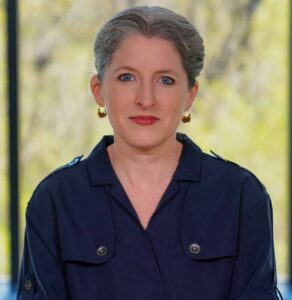
Sarah M. Oliver
The U-M team met with key opera staff this week for initial listening sessions before research begins on the venue’s current practices and how to meet its sustainability goals.
The project begins with a top to bottom review. First meetings bring in the technical director, the costume director and the chief operating officer. In addition, they will look at what is sold during intermission and how that impacts sustainability. They’ll also meet with operations and facilities to learn more about the physical space and how it’s maintained.
“The beauty of the project is that they are thinking of a sustainable season in three years,” Oliver said. “The support from the Graham Catalyst Grant should get us through this first year and the idea is to map their pre-production. Then we’re going to co-develop an action plan based on the findings that we have once we investigate and do all the metrics.”
The group will present its findings to the Detroit Opera House.
“They will drive what they want to do with that data because I think you can have all these ideas about what you want to do, but if you can’t quantify it then you don’t know how to make smart choices,” Oliver said.
In the third year, Oliver plans to work on production sustainability and a case study on the project overall.
“Implementation is always what I hunger for. I’ve been working on sustainability for a long time, and so often you present the report and don’t get to see that follow through. And what’s so exciting about this project is that it’s baked into their goal of a sustainable season and we have the runway to get to that, which is really exciting.”