
Source: Michigan News
Every great river carries great stories in its flow.
Stories of exploration and commerce, yes, but also of connection and belonging, collective action and empowerment.
And so every great river also needs its story keepers.
For the past five years, the University of Michigan’s Detroit River Story Lab has been supporting local efforts to lift up river stories and amplify the voices of their tellers. David Porter, an English professor and founder of the story lab, says he became interested in this collaborative work when he recognized how often community leaders brought up the importance of place-based storytelling in the context of their relationships with the river.
What followed was the development of multiple story-centered projects combining humanities scholarship and community engagement. The lab emerged as a collaboration between an interdisciplinary group of U-M faculty and a variety of local partners. From the outset, Porter said, “the mission was about catalyzing ongoing narrative infrastructure work in river-facing communities. The lab’s initial grant focused explicitly on supporting community-based storytelling projects.”
Since it received that first internal funding in the fall of 2020, the lab has focused on developing three overlapping narrative channels along the Detroit River corridor: place-based education, community heritage, and local journalism.
Today the lab works with dozens of public schools, youth organizations, museums, government agencies, news organizations, and nonprofits to help research and share out a variety of river stories and to support residents’ engagement with the region’s defining waterway through educational programs, interpretive installations, and long-form media stories.
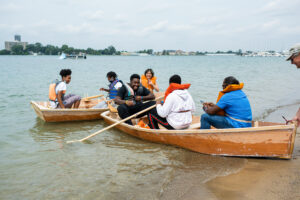
Detroit River Story Lab participants test out the rowboats they build on the Detroit River from Belle Isle. Credit: Austin Thomason, Michigan Photography.
A great example is the Detroit River Skiff and Schooner Program, which was launched in 2021 and provides high school and college students with opportunities such as boat-building workshops and tall ship outings featuring conversations with community experts on the river’s cultural and environmental heritage.
The lab also works with Detroit partners to resurface submerged stories along the river, and to collaborate on site-specific projects at locations including Historic Fort Wayne and the new Gordie Howe Bridge. Oral histories, exhibits and public events all promote environmental stewardship and a greater sense of community. Some of the dozens of projects featured on the lab’s website include an Underground Railroad Research Guide, a Digital Mapping Project featuring historical maps of the Detroit River corridor, and a StoryMap called Lives of Leisure and Labor on the Detroit River.
Some of Porter’s favorite river stories include those about the local histories of Black journalism and Black boating along the river, historical figures like Sarah E. Ray and Thornton and Lucie Blackburn, and present-day community leaders like Hadassah Greensky, Tepfirah Rushdan, Bruce Ross, Jason McGuire, Taylor Mitchell, and Shakara Tyler.
The lab sponsors student internships with the nonprofit news organizations of BridgeDetroit and Planet Detroit to assist them in reporting community stories.
And through the Detroit River Stories Podcast, U-M students interview Detroit residents about their relationship with the river, offering insights on everything from the city’s buried creeks to climate and commerce along the river to the essential role the U.S. Coast Guard plays in the flow of the river.
Another student-led project features a collection of interview-based stories focused on Belle Isle – the swimmers, the walkers, the fishers and the boaters. Porter says: “It’s another important contribution, since for so many Detroiters, the isle is a sanctuary from the city sprawl, a place of peace and reflection and resilience and grounding.”
Units from across U-M have engaged with the lab’s work over the past five years, contributing research expertise, grant funding and program development support. That includes faculty from the College of Literature, Science, and the Arts, the School of Environment and Sustainability, the Marsal Family School of Education, and Taubman College.
Additional U-M partners have included Rackham Graduate School, the Vice Provost for Engaged Learning, the Museum of Anthropological Archeology, the Graham Sustainability Institute, Poverty Solutions, Wolverine Pathways, and the Great Lakes Writers Corps.