

Source: Michigan News

Panel discussion on the UMDC through the years featured Haley Hart, Trina Shanks, Kim Sherobbi, Eric Dueweke and Cindy Gamboa.

Panel discussion on the UMDC through the years featured Haley Hart, Trina Shanks, Kim Sherobbi, Eric Dueweke and Cindy Gamboa.
Moderated by U-M Detroit Center Faculty Director Paul Draus, a panel of five with deep connections to the center and the city spoke about the center’s impact on their careers and endeavors.
Eric Dueweke, retired lecturer U-M Taubman College of Architecture and Urban and Regional Planning.
So I was here on day one. I remember the three deans, my dean at the time, Doug Kelbaugh, and Paula Allen-Meares and Bryan Rogers from the College of Art and Design, and they were the ones who had the vision for this because they were all doing things in Detroit. In my personal case, I started at Taubman in 2002, thanks to my friend and mentor, Margi Dewar, and I was hired as the community partnerships manager, and within a couple of years, that morphed into me becoming a faculty member and teaching and co-teaching many, many capstone courses for the Masters in Urban Planning Program. And most of those projects, and they were all community projects, our clients were always a nonprofit or a city department, most of them were in Detroit, and without this center, we wouldn’t have been able to pull it off.
In fact, when I was being hired for the job, Margi, and especially Doug Kelbaugh, promised me that I would not have to drive from the east side (of Detroit) to Ann Arbor, but that in fact I would be able to work in central Detroit, and it took a couple of years for that promise to come true, but… Yeah, I was really blessed to work in this place for 19 years and made so many good friends here, Craig Regester and many others, that I would never have had the chance to work with from across different departments, especially all the projects we did with Skillman and the School of Social Work, and that interconnection between units just could never have happened in Ann Arbor the way our silos worked. I have two former students here, Britt Simmons, Lou Tallow, and many, many more, who did projects in this place, and still today are doing great work in the city of Detroit for city departments, nonprofits, architecture firms. And without this place to interact with community… Tepfirah Rushdan was part of the Detroit Residential Parcel Survey in 2009.
And we couldn’t have done that super important project without the support of the Ginsburg Center and the U-M Detroit Center to give us free space, and we had, I don’t know, what, 50 surveyors who were in and out of here every day for months. So a lot of great memories and a lot of great impact came out of this building.
Paul Draus
Thanks, Eric. I’m glad you mentioned that about the interconnection or the collaboration that happened here as a result of people being here without necessarily being planned in advance, and that’s one of the things we say here now is that we strive to be a hub and a hive, so not just a place where things intersect and pass each other by, but also we want to actively facilitate conversations, collaborations between the different programs, individuals, organizations that are coming here to use the space, because that, I think, is where a lot of the real innovation starts to happen. So I want to turn to Cindy down there on the end, and Cindy was also once a student of mine.
Cindy Gamboa, executive director of MI Poder.
It didn’t look like this, I’m going to tell you that. I walked in here and it just felt like I was coming back home, and I want to thank you so much and the leadership of this place for just transforming this place into what it looks like now.
We didn’t have that many office spaces, so because a lot of us, like Eric and I, we didn’t want to commute all the way to Ann Arbor. The School of Public Health is a 45-minute drive and I didn’t want to commute, I had babies and all of this stuff. I was the community outreach coordinator for Detroit, a project from the Healthy Environments Partnership, and we were doing behavioral research projects. So I had to be in Detroit, but I also had to be at U-M, so I needed a home, and this was my home. I thought about it as this is our office, and I think when it started, that’s how it was sold, as a working space so we didn’t have to commute, but it just evolved into so much more, it became that connection.
We have amazing partners across the city of Detroit that are doing important work that have their own spaces, but we needed our own. We needed to have our own hub where we can host our community, where our community can have another space to own and feel like they can have those conversations, and that’s what the Detroit Center really was, and that’s what my fondest memories are, of walking in, seeing Eric and Craig and the whole crew, it just felt like we became family and something really beautiful.

Photos from early days of the U-M Detroit Center.
Paul Draus
Thank you. I’m so glad you could be here today, Cindy. I want turn to Kim. Kim Sherobbi is someone that’s sort of like Eric Dueweke, you have a hard time avoiding Kim if you spend any time going to events in Detroit, whether it’s neighborhood events, public events, Kim is all over the place, and she’s been here in the Detroit Center many, many times, participating in different programs here as a representative of different community organizations. So Kim, can you talk a little bit about your experience coming here and maybe your perspective on what it meant for the University of Michigan to be here on Woodward?
Kim Sherobbi, community activist and founder and director of Birwood House.
Well, I got here because I was actually working at the Cass Corridor Commons, and I got here by way of Semester in Detroit. I was the event and building manager at the time of the Cass Corridor Commons. And so, I followed Semester in Detroit students and the group just to come explore, because I heard the building was going to be open. I think that I came to the opening event. I’ll be honest with you, I don’t remember everything, I do remember white walls. I know that there’s a lot of changes that’s gone over, that have occurred over the years. I remember attending a lot of events and being engaged, but nothing specific that is sticking with me. But the one thing I can say is the importance of having this space for community sticks with me, and the fact that the university was trying to open up to the Detroit community and to expand. I’m going to stop there, but I’ll speak more later on about things that’s really resonating with me more.
Paul Draus
Thank you, Kim. And just to my left here is Haley Hart. And so, Haley is probably one of the people that’s here most, I would say. The program that she runs, Michigan Engineering Zone, is probably our biggest user at the Detroit Center. So Haley, can you talk about what brought you here and what your experience has been working here?
Haley Hart, director of the Michigan Engineering Zone.
Okay, thank you. So I’m someone that thinks of myself as someone who just builds Legos and robots with kids every day, so first of all, it’s just an honor to be up here with this group. But one of the things that I love about the Detroit Center is the humility that the place has and the way that, as an educator and as someone that runs programs with youth, our youth are welcome in this space as well.
I was not here on day one, but my first interactions with the Detroit Center were in around 2013. I was a teacher at the time at Southeastern High School and I was bringing my robotics team here to participate in activities at the Michigan Engineering Zone, where I now work, that we were running. My students and myself, we would be bringing carts with robots right down the cubicles, when we were on the other side of the building, just bringing them right down the middle of the offices, making lots of noise, not your typical office environment, but there was an openness and a welcomeness to us and our students, and there always have been.
There was a little bit of time when my office was over on that side, when we were located on the other side of the building, that Lieutenant Governor Garlin Gilchrist had an office space just on the other side of the cubicle from me. And so, I think about, again, Detroit youth bringing their robots down in an office space, where the now Lieutenant Governor was just sitting right there doing his work and having people like Representative Tlaib and I’ve seen Mayor Duggan here before. This place is just so magical in that there are big changemakers in our community that come here for events, and then there are Detroit middle schoolers that are here building robots, and the fact that those two things can happen just side-by-side is part of the magic of this place, in my opinion.
Paul Draus
Thank you. I think that is so important here, that we try to be a welcoming, supporting environment for all of our different constituents and users, whether it’s community-based organizations that are using this space, whether it’s our faculty that are coming and using this space, or whether it’s middle school or high school kids that are here and we want them to be at home and supported here and safe here and welcome here.
So the Detroit Center has changed a lot over the years. I wasn’t the first director of the Detroit Center, I should acknowledge the previous directors. Roger Doster, I think, was the first director. Then Dr. Addell Anderson was the director following Roger. Feodis Shipp III, and I joined in 2023. And over those years, the Detroit Center has also changed and evolved in terms of its mission or its focus. And so, I wanted to turn it to the panel and ask your thoughts or reflections on how the Detroit Center, from your perspective of using it, has changed or evolved over the years, or if you want to talk about U of M’s presence or commitment in Detroit, how it has changed or evolved over the years from your perspective.
Kim Sherobbi
So the center has always been active, as everyone said, a lot of activities for people to come and to participate in, a lot of learning that has gone on. But what’s really resonating with me is the fact that the center didn’t stay here. So in 2022, as you know, Paul, we had the Engage Detroit Project. And so, the center actually moved to neighborhoods. Having the center and the resources from the U of M center go into the neighborhoods was very, very special to me. It was like 50 of my neighbors, it was 80 people at an event that we hosted for that initiative. But 80 of my neighbors, who will not make it down here, I do invite them, but for them to actually get to meet the professors and take part in some of their resources that U of M center has was unbelievable, and we did that throughout the city. So that actually was something that resonated with me. I know Semester in Detroit is out throughout the city, but this was literally something that was citywide and not just specific to students. So that was very different, and I hope you all continue to do that, to bring your resources into community.
Paul Draus
Yeah. And I should mention that that was a program, the Engage Detroit Workshop Program, which is out of the vice provost for Engaged Learning Office, that’s Vice Provost Bertacco and Morgan Yuncker. But that was a program supported by the vice provost office, and the whole idea of the Engage Detroit Workshop Program is to get U of M faculty, students and staff out working with community residents, organizations, stakeholders, in either here at the Detroit Center or at other locations in Detroit. And again, that’s part of our vision here at the Detroit Center now is that the Detroit Center is here as a physical space, but the Detroit Center is also a constellation.
So thank you for remembering and sharing that memory.
Paul Draus
All right. So anyone else want to talk about the evolution of the mission or the work at the Detroit Center over the years?
Trina Shanks, U-M professor of social work
Yeah, I’ll say a little bit. So I’ll say it from work that I and others as social workers have been doing, but as you’re here, it’s intersected with a lot of other people in a lot of the schools, a lot of other places. So for those of you who aren’t familiar with Skillman and the Good Neighborhoods, that was Carol Goss’ vision to go to six communities in Detroit where there are lots of children, lots of poverty, and to take it from being a foundation giving grants for what they wanted to training leaders and people to have resident voice create institutions that they want. And so, that’s where my first ongoing interaction with the Detroit Center and with the Detroit communities.
And so, we, just like Eric and Cindy said, had offices over on the other side where we had space. Those offices were taken away when we came over here, but at that moment, we had a space where everybody could come. And so, we had a leadership academy where people from the neighborhoods came and got a certificate to learn how to be community leaders. We ran an AmeriCorps Program, where we supported Detroit-based organizations and recruited from neighborhoods, and they came in and out of this building. We also placed field students in local communities, and this is where they came to get their supervision and to meet as a group. And we actually published a whole book on that 10 or 11 years worth of work. But then, we also started working with Kellogg to do things around employment equity and housing equity. And so, it wasn’t so much that we had offices here and worked here every day, but we had all sorts of convenings around ideas about spaces and people came in and out.
We also worked with someone at the Ross School of Business to actually offer real estate education to the community, and so he helped partner and design the program for three years, what was called Real Estate Essentials. But then, we worked with someone from Detroit who came back, Chase Cantrell, but he was something called Building Community Values, so he took over and now has expanded that program and made it even bigger and better. So it went from U of M students learning about real estate and how to do business in Detroit to residents learning about how to create value for themselves in Detroit, and so just seeing that grow over time.
And one other thing is when there was the university trying to decide what their ongoing role was going to be in Detroit, there’s always these special committees and convenings, and so we’ve had all these conversations, some of you in the room have been on those. And so, the most recent configuration of that is the Detroit Advisory Group, which I’ve been a part of since it started. But again, we never really come to any final decisions and say, “This is the vision, this is the role,” but it always is a way to continue having input, both from faculty and from residents and from people, some who are critical and some who are not.
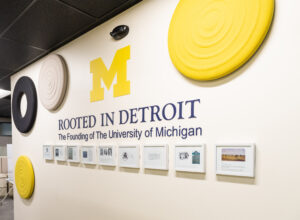
U-M Detroit Center
Paul Draus
I was looking down to see if Erica or Cindy wanted to jump in on this question?
Cindy Gamboa
Yeah. I’m hearing it all and I’m just trying to take it all in, because again, this was an office space so the evolution was huge. When you think about where we started, I think there was the conversations where when we showed up, then we started to dream about what the potential of this place could be, and that’s when the magic really started to happen. If we didn’t have this place here located in the city, then we couldn’t open up the potential to interact with our beautiful city, with our residents, with our neighbors, so that’s actually when we started to see the growth.
For my work here, I wouldn’t have been able to be as impactful in some of the behavioral health research projects that we were leading at the time. We were doing walking groups with the Walk Your Heart to Health Program, we were really trying to figure out what are sustainable, healthy ways to start to combat cardiovascular disease in the city, because that was huge amongst Black and Latino residents in the city. So not us coming in to impose and say, “This is what you have to do,” but learn from our communities, be a partner and trying to shape.
We worked closely with the Urban Research Center and we did community-based participatory research, and you can’t do that… Your community is an active partner, and you can’t do that from U of M, you have to be true to what you’re really trying to put in practice, you’ve got to walk the walk. So really being here, being an active partner, listening to community, to what community needed, really shaped a lot of the programs that we put in place.
So Walk Your Heart to Health was actually a community-driven project, where people are like, “Hey, we’re not going to be doing no yoga, we don’t want to do that, but we can walk.” And we actually got Chandler Park and it’s beautiful, so that’s where we’re going.So we were down at the riverfront before it was beautiful, we were at Chandler Park, we were in Southwest Detroit and Patton Park. So we were in the areas where community said, “This is where you’ve got to be. If you want to be authentic and you want us to actually see some results, some change in our community, this is where you’re going to show up in.” So really, because we have this presence, we were able to respond to what community was facing, what they said they needed.
Rashida talked about it a little while ago, where we have the highest asthma rates in the city. What are we doing about it? Our communities keep saying it. It’s not normal that all of our babies have inhalers that they’re putting on their teacher’s desk at the start of their class. What are we doing about it? How are we being responsive to community needs? The Urban Research Center had a multi-year program that was led by CAAA, I always get acronyms wrong because it’s always alphabet soup with U of M, y’all, we’ve got to figure it out, but Community Action Against Asthma, I think I got that right. But we hired… Right? The acronyms.
But we hired residents, because who knows our community better than our neighbors? So we trained up community, we brought them to the Detroit Center, we gave them the training, we had professors come in and talk about the science and how do we help our neighbors, how do we do assessments so we’re getting the research that can actually help us continue to organize our community and elevate policy needs to people like Rashida that are fighting for us, how do we make sure that our voices are heard? And I think that’s the evolution that really is impactful, that I think we need to start telling that story, and if these places didn’t exist, all of this would not have been possible.
Paul Draus
Thank you, thank you, Cindy. And shout out to the Urban Research Center.
Eric Dueweke
I was at their 30th anniversary celebration last Friday, and so when we came here, we were standing on the shoulders of the School of Public Health and Barbara Israel and the whole notion of community-based participatory research where you involve community as equals to scholars, and so we have to acknowledge that we stand on those shoulders.
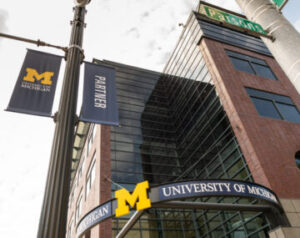
Photo credits: Credit: Scott Soderberg, Michigan Photography
Paul Draus
I think it’s fair to say that that ethos is one that we actually hold very close to the center of everything we do here at the Detroit Center. So I did get a signal, we’re getting short on time. I do want to offer you an opportunity to share a memorable moment here at the Detroit Center. I’m going to throw this open everybody. Actually, I’m going to start with Haley, because I know with all the kids running and out of here, there’s a lot of memorable moments.
Haley Hart
Well, thank you. As Paul said, we’re here, the Michigan Engineering Zone are bringing students into some of the rooms here at the Detroit Center almost daily, so there’s a whole lot of memories to choose from, and we couldn’t do our work without partnership with you all, so just really appreciate the relationship that the MEZ and the U of M Detroit Center have had over the… We’ve been around for 15 years, so we’re celebrating our 15th year anniversary the same year you all are celebrating 20.
I think there’s not a big memorable moment for me. I think I reflect more on these smaller moments, like I talked about, with just seeing Detroit students in the space building and creating and bringing their ideas and their contributions, and those being honored within this space in a similar way that some of our most powerful politicians and some of our most well-known faculty members, just the way that all of those things in the U of M Detroit Center, everyone’s contribution is valued in a way, regardless of age or origin. It’s really about lifting up the city of Detroit and Detroiters and making sure that there is a physical space, but also resources and opportunities for folks here in Detroit, and I think also connecting Detroiters back to the larger work of U of M in Ann Arbor, in Dearborn and Flint. I think this is just a hub, a connection point, between so much good work that’s happening between U of M and the Southeast Michigan community.
Paul Draus
And I think that’s really what makes a city great too. So I think what we try to do here is, in Detroit Center, some of the things that happen here are part of what makes this place great is also what makes it great to be in a city, it’s that serendipity. You don’t know who you might run into in any given day because of the number of people that are crossing paths and interacting, that’s part of the magic of being in a great city as well. But I want to reserve the last comment, because I think we’re at the last comment, for Eric, because I know you’ve got a memory or something you want to share.
Eric Dueweke
I have so many memories. But when you gave me this question, the first thing that popped into my mind was in the summer of 2013, there was a 50th anniversary celebration/recreation of MLK’s 1963 march down Woodward Avenue that had over 100,000 people, and that march culminated at Cobo, where he gave the first version of “I Have a Dream.” And because of the location of this place, it became the kickoff point for the recreation of thousands of us who were too young to be there in ’63, but able to march down Woodward, and I know that the U of M Black Alumni Association was a big part of that, putting that together, and they have had a home here.
But that stuck out for me, and just the fact of where we’re located, right here on the main street in Detroit, at the intersection of Martin Luther King Boulevard, I think, says something in and of itself.
Paul Draus
Thank you, Eric. And with that, I want to thank our whole panel.