
Source: U-M SEAS Detroit Sustainability Clinic
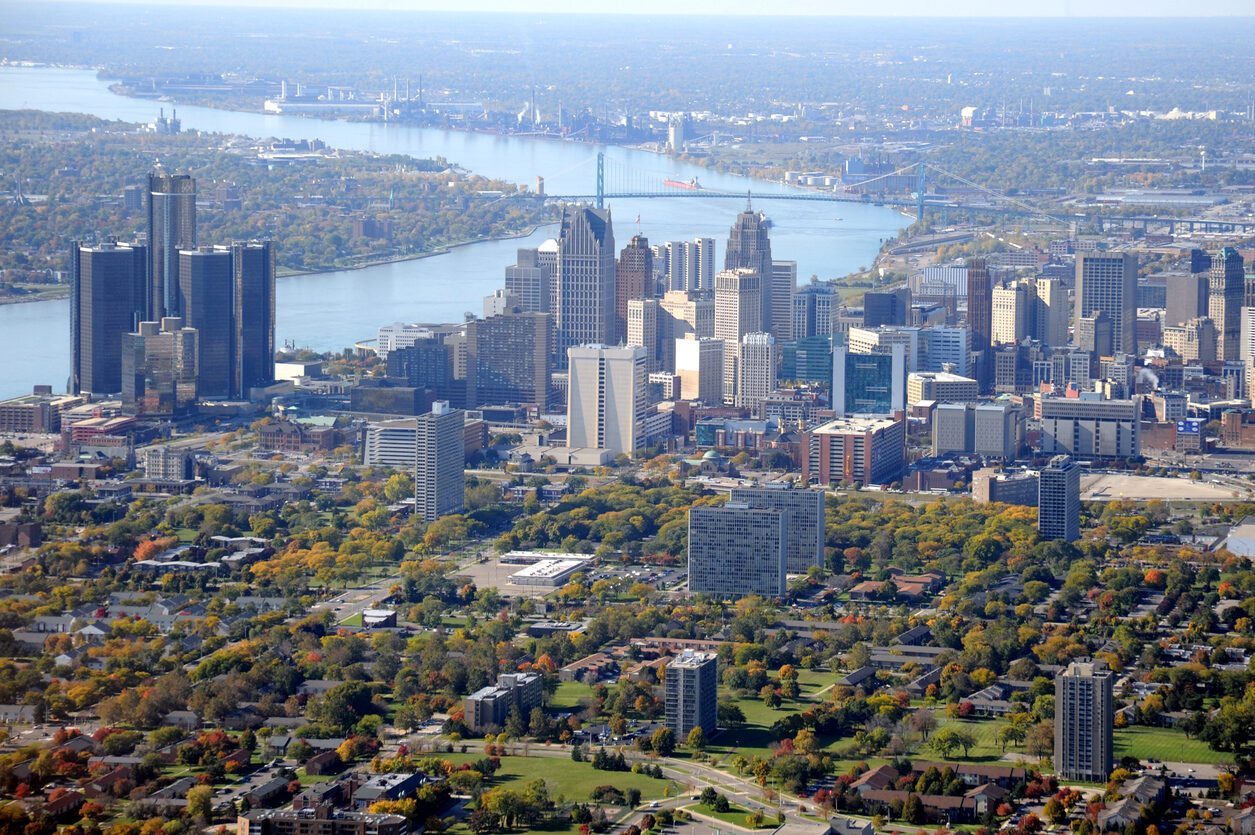
Aerial view of Detroit, Michigan, on the Detroit River, looking south. Credit: tomprout/iStock
Aerial view of Detroit, Michigan, on the Detroit River, looking south. Credit: tomprout/iStock
As cities across the country invest billions of dollars in clean energy and climate infrastructure, a critical question remains largely unanswered: Are these investments working for the people who live closest to these projects?
Researchers from the University of Michigan and Michigan State University received a $1 million grant from the Alfred P. Sloan Foundation to launch a first-of-its-kind research initiative to examine how cities can reduce carbon emissions through clean energy investments, while ensuring the communities where these projects are built have a voice in the process and share their benefits.
As cities make major investments in clean energy, understanding who benefits — and who has a say in those decisions — could help communities make the most of the transition while reducing emissions.
The three-year research project, “Decarbonizing the Hood: Conditions, Perceptions, Principles and Evaluation of Equitable Urban Energy Transitions,” brings together researchers, students and community partners to study six urban decarbonization initiatives across Detroit, Chicago and Columbus.
The initiative is led by principal investigator Tony Reames, Tishman Professor of Environmental Justice and director of the School for Environment and Sustainability, or SEAS, Detroit Sustainability Clinic and Urban Energy Justice Lab, and co principal investigator Meghan Wilson, assistant professor of American politics and public policy at Michigan State University’s Department of Political Science.
“This project gives us a unique opportunity to understand how residents participate in planning processes, how benefits and burdens are distributed, and how local governance shapes project outcomes,” Reames said. “Those insights will help us better understand what it takes to advance energy transitions that are not only effective but also equitable.”
Continuing reading the story from the SEAS Detroit Sustainability Clinic